In this post we review the proof of the Bott periodicity theorem for C*-algebras, generalizing the original Bott periodicity theorem from homotopy theory (and topological K-theory).
Bott periodicity is on of the major theorems of K-theory. Let’s start by introducing the needed definitions. First of all, given a unital C*-algebra  the group
  can be treated as the algebraic K-group of the C*-algebra , which is just the quotient of the collection of idempotent matrices in
  by the equivalence relation of similarity meaning two idempotents
  and
and  are similar if there exists numbers
  such that
  and an invertible
  such that
![\[V(A_n\oplus 0_s)V^{-1} = B_m\oplus 0_t \in M_{n+s}(A).\]](https://www.mathblog.realhjelp.no/wp-content/ql-cache/quicklatex.com-a28c7c9cee4bb9a50190f6a652f71c42_l3.png "Rendered by QuickLaTeX.com")
We define the group  (which is different from the algebraic
  group of ) where
![\[SA = C_0((0,1), A)\]](https://www.mathblog.realhjelp.no/wp-content/ql-cache/quicklatex.com-16ed58501c4785e83fcce33e2b8e23bd_l3.png "Rendered by QuickLaTeX.com")
is called the suspension of
. The group of is most often defined as the quotients ![\[K_1(A) = U_\infty(A)/U_\infty(A)_0 = GL_\infty(A)/GL_\infty(A)_0\]](https://www.mathblog.realhjelp.no/wp-content/ql-cache/quicklatex.com-91f3388f5f4e53ffcf06252ec3f6a186_l3.png "Rendered by QuickLaTeX.com")
where the subscript
 denotes the connected component of the identity. Here we see more clearly how the topology of the algebra comes into play. See Theorem 8.2.2 of [3] for the proof of the equivalence of these two definitions.
The construction of the  groups are (covariantly) functorial, by letting a morphism act on the element of the matrix representing the idempotent, and if happens to be non-unital then we define the groups
  as the kernel of the lift
![\[\phi_\star : K_n(A_1)\to \C\]](https://www.mathblog.realhjelp.no/wp-content/ql-cache/quicklatex.com-a03e923f62d4b547b09fd3b636ebd92a_l3.png "Rendered by QuickLaTeX.com")
 (the unitization of ) to
  .
.
There are two important benefits to using the suspension construction to define the higher K-groups. For starters it can be used just like the spectrum of a generalized cohomology theory in topology, to produce a family of functors by the assignment
![\[K_n(A) = K_0(S^nA).\]](https://www.mathblog.realhjelp.no/wp-content/ql-cache/quicklatex.com-04c13ae5c20fabeb657c4b9db04d9e63_l3.png "Rendered by QuickLaTeX.com")
Which yields for every short exact sequence of C*-algebras
![\[0\to B\to C\to A\to 0\]](https://www.mathblog.realhjelp.no/wp-content/ql-cache/quicklatex.com-eaa6c0c2dd089850a32cbe94e93c6e13_l3.png "Rendered by QuickLaTeX.com")
a long exact sequence of abelian groups
![\[... \to K_0S^n(B)\to K _0 S^n(C) \to K _0 S^n(A) \to K _0 S^{n-1}(B) \to ... \to K _0 (A)\]](https://www.mathblog.realhjelp.no/wp-content/ql-cache/quicklatex.com-361a8dc397c139e1c69f0e628aa87c1f_l3.png "Rendered by QuickLaTeX.com")
see theorem 11.1.12 of [1] for the definition of the connecting morphisms  (spoiler, the last one is simply
 ![\delta(x) = [wp_n w^\star] - [p_n]](https://www.mathblog.realhjelp.no/wp-content/ql-cache/quicklatex.com-b4c2ce848b59a3789d14bc223d71efab_l3.png "Rendered by QuickLaTeX.com") where
where  is the lift of the two unitaries
  with
with  representing
  in
in  and
and  some unitary in
  for which
  becomes homotopic to the identity matrix). Note that such a unitary always exists and that
  can always be lifted, since any surjective morphism of C*-algebras induces a bijection on the connected component of the identity of the unitaries (see resp. Corollary 4.3.5 and Corollary 4.3.3 of [1]).
The other benefit of using the suspension notation is that one can more clearly see what the second K-theory groups should look like, since the split extension
![\[0\to SA\to C(\mathbb{T}^0, A)\to A\to 0\]](https://www.mathblog.realhjelp.no/wp-content/ql-cache/quicklatex.com-09018825088705618c3a7834943bc9dc_l3.png "Rendered by QuickLaTeX.com")
 is the circle) yields a split extension
![\[0\to K_1(SA)\to K_1(C( \mathbb{T}^0 , A))\to K_1(A)\to 0.\]](https://www.mathblog.realhjelp.no/wp-content/ql-cache/quicklatex.com-04e1bd95ffdbbdef52a312cf231b881d_l3.png "Rendered by QuickLaTeX.com")
With the identifications
![\[K_1(C( \mathbb{T}^0 , A)) = GL_\infty( C( \mathbb{T}^0 , A)) / GL_\infty( C( \mathbb{T}^0 , A))_0 \simeq C( \mathbb{T}^0 , GL_\infty(A))/ C(\mathbb{T}^0, GL_\infty(A) )_0\]](https://www.mathblog.realhjelp.no/wp-content/ql-cache/quicklatex.com-552cd70655b6b53e6e1a7a3e3f82aff3_l3.png "Rendered by QuickLaTeX.com")
we see that  is nothing but the (groupoid of) homotopy classes of loops with arbitrary base points. The lift of the quotient map is just the evaluation map at
 ![1 \in \mathbb{T}^0 \simeq [0,1]/0\sim 1](https://www.mathblog.realhjelp.no/wp-content/ql-cache/quicklatex.com-5c3489f363ecc7e65ca57e84502022cb_l3.png "Rendered by QuickLaTeX.com") , so we get that the kernel of this quotient map is just
, so we get that the kernel of this quotient map is just
![\[K_2(A) = K_1(SA) = K_0(S^2A) \simeq \pi_1(GL_\infty(A)).\]](https://www.mathblog.realhjelp.no/wp-content/ql-cache/quicklatex.com-bf7fa688b1aae89e1668a23b9e4eba2f_l3.png "Rendered by QuickLaTeX.com")
 the fundamental group is
  .
.
We will need to know that the K-theory functor is stable (meaning  , half exact (meaning its sends short exact sequences to sequences that are exact in the midle) and homotopy invariant. An elementary proof of these facts can be found in most book on operator theory like [2] and/or [1]. We note also that the condition of homotopy invariance is implied by split exactness and stability (see for instance Theorem 46 of this paper), and that the above conditions imply the functors is split exact and additive (Theorem 11.1.7 of [1]).
The remarkable fact is that these properties alone assures us that the functor  satisfies Bott periodicity theorem, that is, the infinite sequence of groups
  is determined by its first two entries. More precisely
be a C*-algebra, then
![\[K_{i}(A) \simeq K_{i+2}(A) \qquad \text{for all } i\]](https://www.mathblog.realhjelp.no/wp-content/ql-cache/quicklatex.com-a1070c0f355e13304f65c6413ddd2797_l3.png "Rendered by QuickLaTeX.com")
There are many proofs of this theorem. In [3] the author shows that the map
![\[\beta_A : K_0(A) \to K_2(A)\]](https://www.mathblog.realhjelp.no/wp-content/ql-cache/quicklatex.com-25a881e4ebb37613493e0dda064a7c28_l3.png "Rendered by QuickLaTeX.com")
![[e] \in GL_\infty(A)](https://www.mathblog.realhjelp.no/wp-content/ql-cache/quicklatex.com-5ba782becb798c8e868b93c6d22b0b6c_l3.png "Rendered by QuickLaTeX.com") to the loop
to the loop  determined by
![\[f_e(z) = ze +(1-e)\]](https://www.mathblog.realhjelp.no/wp-content/ql-cache/quicklatex.com-375db5c7447bb8174e8d27cc7c0441bc_l3.png "Rendered by QuickLaTeX.com")
is an isomorphism. Here we will repeat the proof of Cuntz, that can be found in [1]. For that we will need to introduce the Toepliz algebra
 defined as the C*-subalgebra of
  generated by
  and the unilateral shift operator
![\[S(e_1, e_2, ...) = (0, e_1, e_2, ...).\]](https://www.mathblog.realhjelp.no/wp-content/ql-cache/quicklatex.com-0342d265bc2d4ca51459a0c70dc86b08_l3.png "Rendered by QuickLaTeX.com")
Note that  , so
, so  hence
hence
![\[(S^{n-1}(S^\star)^{n-1} - S^n(S^\star)^n)(e_1, e_2, ...) = (0, ..., 0, e_n, 0, ...).\]](https://www.mathblog.realhjelp.no/wp-content/ql-cache/quicklatex.com-fd5cf95a069a9a3bb8fdf92d994e1cee_l3.png "Rendered by QuickLaTeX.com")
From this one can deduce (after some work) that the algebra generated by
 and contains all the rank 1 projections, which in turn span the finite rank operators (Theorem 2.4.6 of [2]). Since these are dense in the compact operators we conclude that
  . Since
![\[(S^\star S - SS^\star)(e_1, e_2, e_3, ...) = (e_1, 0, 0, ...)\]](https://www.mathblog.realhjelp.no/wp-content/ql-cache/quicklatex.com-4ee8591a75871ae88abd9519afca260c_l3.png "Rendered by QuickLaTeX.com")
descends to a unitary operator on  , from which we conclude that
  Note now that
  is not invertible for any
  . One can show it is not surjective, but it is just as easy to see that it is not bounded away from 0 (meaning there exists a sequence of unit lenght vectors
  such that
  . To see this, take
  to be a complex number such that
  and let
  with , then
  and
and
![\[|| (S - \lambda I)v|| = 2 |e_1| \to 0.\]](https://www.mathblog.realhjelp.no/wp-content/ql-cache/quicklatex.com-b46c939681f514f66a96548b68fdba7e_l3.png "Rendered by QuickLaTeX.com")
A similar argument can be used to show that  is not invertible for any finite rank operator hence, using that the invertible operators form an open set, we conclude that
  is not invertible for any compact operator. Once the argument is repeated for
  we can conclude that
  .
.
The subalgebra of functions in  vanishing at 1 is generated by the the polynomials centered at 1 (Weierstrass theorem), hence by the function
  on
on  , which under functional calculus correspond to the operator
  in . Denote by
  the subalgebra generated by . We have
![\[\mathcal{T}_0/\mathbb{K}\simeq C_0(0,1)\]](https://www.mathblog.realhjelp.no/wp-content/ql-cache/quicklatex.com-3bbd131d808bfcf3dca33449e378be2e_l3.png "Rendered by QuickLaTeX.com")
Now by tensoring with the exact sequence  with we get an exact sequence
![\[0\to A\otimes \mathbb{K} \to A\otimes \mathcal{T}_0\to SA\to 0\]](https://www.mathblog.realhjelp.no/wp-content/ql-cache/quicklatex.com-e1a62e25fa20daf0eaee4c2ed37a3090_l3.png "Rendered by QuickLaTeX.com")
Recall that tensoring with a fixed C*-algebra is always exact on exact sequences of nuclear C*-algebras (just as with flat modules). Wrinting for the functor, we get from this a long exact sequence of K-theory groups
![\[... \to KS(A\otimes \mathbb{K} )\to K(SA\otimes \mathcal{T}_0) \to KS^2A\to K(A\otimes \mathbb{K} )\to K(A\otimes \mathcal{T}_0) \to KSA.\]](https://www.mathblog.realhjelp.no/wp-content/ql-cache/quicklatex.com-076973da60ec30df50e5f9d9c1c7a65d_l3.png "Rendered by QuickLaTeX.com")
The goal now (and a result of independent interest) is to show that  for any
  , this would imply that the map
  is an isomorphism. Here we use the fact that is stable. The sequence
![\[0\to \mathcal{T}_0\to \mathcal{T}\xrightarrow[]{p} \C \to 0\]](https://www.mathblog.realhjelp.no/wp-content/ql-cache/quicklatex.com-f84b34e14195fc8b272d1f403868c0c7_l3.png "Rendered by QuickLaTeX.com")
is split by the unital morphism  since
since  , hence using the split exactness of we get a new split exact sequence
![\[0\to K\mathcal{T}_0 \to K\mathcal{T} \xrightarrow[]{p_\star} K\C\to 0\]](https://www.mathblog.realhjelp.no/wp-content/ql-cache/quicklatex.com-f7e82e8586db4c2ea91314b94249bad3_l3.png "Rendered by QuickLaTeX.com")
By split exacness,  . We will show that
  yielding that
  since
since  is an isomorphism of abelian groups and the sequence is exact).
Given a minimal projection  (like
(like  ) in a C*-algebra there the standard way to construct an imbedding
![\[B\to B\otimes \mathbb{K} \qquad b\mapsto b\otimes p\]](https://www.mathblog.realhjelp.no/wp-content/ql-cache/quicklatex.com-fe38966f3ccb202fcc1f9a90b20549cc_l3.png "Rendered by QuickLaTeX.com")
which induces an isomorphism in -theory. By letting  be the induced map using the (rank 1) projection
  we get an isomorphism of their respective -groups, so we may as well work with the latter.
From here on out, things will get a little more sketchy, but the idea is to use a larger C*-algebra  to produce a homotopy between
  and
and  , then using the homotopy invariance of . From the above C*-algebra one gets exact sequences
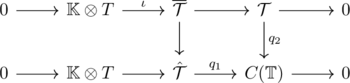
where  is the quotient map by
  and
and  is the quotient map by
  , and
, and  is the fibered broduct (or pullback) in the category of C*-agebras (see this article by Pedersen for a good overview of pullback and pushout constructions of C*-algebras). Note that the full subcategory of separable C*-algebras is closed under pullbacks,
The upper sequence turns out to be split exact, hence since we assume is split exact we get that  is injective.
Homotopies in operator theory seem to be a wellspring of convoluted formulas and the next one is no exception. Let
![\[v = S\otimes 1 \quad w = (1-SS^\star)\otimes S \quad e = (1-SS^\star)\otimes (1- SS^\star).\]](https://www.mathblog.realhjelp.no/wp-content/ql-cache/quicklatex.com-2173c4259b01476a5fee9d35048e6ec5_l3.png "Rendered by QuickLaTeX.com")
![\[u_0 = v^2v^{\star 2} - w v^\star + vw^\star + e\]](https://www.mathblog.realhjelp.no/wp-content/ql-cache/quicklatex.com-e96a39e783de5a955507270836b33a76_l3.png "Rendered by QuickLaTeX.com")
and define the two self-adjoints idempotents
![\[u_1 = v^2v^{\star 2} + (1 - vv^\star) v^\star + v(1 - vv^\star).\]](https://www.mathblog.realhjelp.no/wp-content/ql-cache/quicklatex.com-9474821cf3da8bbb89f6d69f8e02e1c7_l3.png "Rendered by QuickLaTeX.com")
Using the fact that any self adjoint unitary  is homotopic to the identity (by the path of unitaries
  ), we can conclude that
  and
and  are homotopic.
Let
![\[\alpha_t: \mathcal{T}\to \hat{\mathcal{T}} \qquad \alpha_t(S) = u_t(S\otimes 1)\]](https://www.mathblog.realhjelp.no/wp-content/ql-cache/quicklatex.com-50a4749d50f50a49a5c0a4d841d49793_l3.png "Rendered by QuickLaTeX.com")
note that this determines  since and
  generate and that
  is clearly homotopic to
  . Now set
![\[\beta_t : \mathcal{T} \to \overline{\mathcal{T}} \qquad \beta_t(S) = \alpha_t(S)\oplus S.\]](https://www.mathblog.realhjelp.no/wp-content/ql-cache/quicklatex.com-e12d85407f0743b9dc357db885bea034_l3.png "Rendered by QuickLaTeX.com")
Denote by  the function
  and using the additivity of we get
![\[\beta_{0\star} -\gamma \star= \iota_\star \sigma_\star\]](https://www.mathblog.realhjelp.no/wp-content/ql-cache/quicklatex.com-57b7be5c26609977ceaf0fdb41b57513_l3.png "Rendered by QuickLaTeX.com")
and
![\[\beta_{1\star} - \gamma= \iota_\star\sigma j_\star p_\star\]](https://www.mathblog.realhjelp.no/wp-content/ql-cache/quicklatex.com-0dbf44b1e53f0d552470a500d13d27c5_l3.png "Rendered by QuickLaTeX.com")
from homotopy invariance of we conclude that
![\[\iota_\star \sigma_\star = \iota_\star \sigma_\star \j_\star p_\star\]](https://www.mathblog.realhjelp.no/wp-content/ql-cache/quicklatex.com-a0412b7a625b64466f45d35cfdff8bfd_l3.png "Rendered by QuickLaTeX.com")
but since  is injective hence a left cancellable monomorphism, we conclude that
  , which concludes the proof.
Bibliography
[1] – Wegge-Olsen: K-theory: A friendly approach[2]- Murphy: C*-Algebras and Operator Theory
[3] – Blackadar – K-theory for operator algebras