
Having had a hard time finding this material in English I decided to make a post on it myself. Here is a proof of the existence of a universal compactification of  -space of various types.
In what follows will denote a fixed locally compact group,  will denote a Tychonoff space with a continuous -action (henceforth a -space), and
  will denote the family of all its -compactifications (up to equivariant isomorphisms). We say that a compact -space
  is a -compactification of a -space if the exists an equivariant topological embedding
  , usually taken to have dense image.
The collection of all -spaces which admit a compactification is called -Tychonoff spaces and are characterized by the following property – for any closed set  and any point
  there exists a -uniform function
 ![f : X \to [0, 1]](https://www.mathblog.realhjelp.no/wp-content/ql-cache/quicklatex.com-fd1ae3c480864a4d06cad1092a1f41bc_l3.png "Rendered by QuickLaTeX.com") (i.e. a function uniformly continuous on each fixed -orbit) such that
(i.e. a function uniformly continuous on each fixed -orbit) such that  and
and  .
.
For our purpose we will only need to know that if is a Tychonoff space then is a -Tychonoff space in the above sense (a result proved by Vries in [1]), hence is not empty.
There is a partial ordering on determined by  if the identity map on lifts to a surjective equivariant continuous map
  . In this case we say that
  dominates
  . Given a linearly ordered subset of (called a chain),
![\[… \to \overline{X}^{a_n}\xrightarrow[]{f_{n-1}}… \xrightarrow[]{f_0} \overline{X}^{a_0}\]](https://www.mathblog.realhjelp.no/wp-content/ql-cache/quicklatex.com-41d687244a5f720391044e7eec99fa46_l3.png "Rendered by QuickLaTeX.com")
the resulting projective (or inverse) limit space 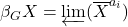 is also compact and admits a strongly continuous -action.
To see this, recall that elements in the limit space  can be thought of as sequences
  where
where
![\[x_i \in X^{a_i} \qquad \text{and } \qquad f_n(x_{n+1}) = x_{n}\]](https://www.mathblog.realhjelp.no/wp-content/ql-cache/quicklatex.com-6db33b0f01d4630136b803c56c4515c4_l3.png "Rendered by QuickLaTeX.com")
endowed with the weak topology given by the projections
![\[p_n: \beta_GX\to X_n \qquad (x_i) \mapsto x_n.\]](https://www.mathblog.realhjelp.no/wp-content/ql-cache/quicklatex.com-734faaa53ca6d7bce3847c161b3b4a64_l3.png "Rendered by QuickLaTeX.com")
action on given by ![\[g\cdot (x_i) := (gx_i)\]](https://www.mathblog.realhjelp.no/wp-content/ql-cache/quicklatex.com-1fc575d2a5b1639bc14374506a8b43cb_l3.png "Rendered by QuickLaTeX.com")
 is continuous if and only if
  is continuous for all
  we immediately get that the map
 ![\[G\to \beta_GX \qquad g \mapsto g\cdot (x_i)\]](https://www.mathblog.realhjelp.no/wp-content/ql-cache/quicklatex.com-c630a09be5c2b5bac27d8d4e3d53dab7_l3.png "Rendered by QuickLaTeX.com")
 .
.
Compactness of the limit requires some thought, but follows from the fact that a limit of compact Hausdorff spaces is a compact space (see for instance [2] Theorem 5).
Hence if we only require strong continuity we may employ Zorn’s lemma to create a “maximal” compact (topological) -space with a strongly continuous -action.
However, we can say even more – from Ellis theorem any action
![\[F: G\times Z \to Z \qquad (g, z)\mapsto gz\]](https://www.mathblog.realhjelp.no/wp-content/ql-cache/quicklatex.com-147ffe09f1cced634cbeb658d4e62175_l3.png "Rendered by QuickLaTeX.com")
on a compact space  which is continuous in each variable is automatically continuous. So the maximal -compactification is actually a compact -space. This universal -compactification is often denote by to mirror the notation of the Stone-Cech compactification, and is characterized by the following universal property –
If is a -compactification of such that the identity map on lifts to a surjective map
![\[Y\to \beta_GX \quad \text{then} \quad Y\simeq \beta_GX.\]](https://www.mathblog.realhjelp.no/wp-content/ql-cache/quicklatex.com-04b08f3ca1664dcd828db6c31699e33c_l3.png "Rendered by QuickLaTeX.com")
In some special cases we have an actual homeomorphism  . This happens if for instance is discrete, or acts trivially on , or if is pseudocompact (the latter is proven in [3]).
If one wishes to specialize to subsets of with specific topological attributes, here that are some properties which are preserved by projective limits with morphisms given by surjective equivariant continuous maps –
- being compact Hausdorff
- being non-empty compact Hausdorff
- being connected compact Hausdorff
- being compact Hausdorff of covering dimension
 .
. - being topological complete (spaces that admit a complete metric inducing its topology).
That is to say, if we take for instance the collection  of topologically complete -compactifications of (may be empty) the maximal -compactification will be a topologically complete metric space. In general being a metric space, being paracompact or being compact is not preserved under inverse limits unless one puts some requirements on the connecting morphisms.
The case of metric spaces – Looking more closely at the case of metric -compactifications, let  and
and  be two such compactifications. Since imbeds into both these metric spaces as a dense subset, the compactifications can be treated simply as the completions of with respect to two distinct metrics
  and
and  , where and induce the same G-compactification if and only if they are uniformly equivalent (not to be confused with strongly equivalent). This follows from existence and uniqueness theorem of completions of metric spaces and the fact that a compact metric space must be complete.
In the above example we can hence assume the two spaces are completions of with respect to some choice of metrics, say and . We see that  if and only if every Cauchy sequence in is also a Cauchy sequence in . The metric
![\[\tilde{d} = max\{d, d'\}\]](https://www.mathblog.realhjelp.no/wp-content/ql-cache/quicklatex.com-5a67c6bd0a3a548391914915719f00ec_l3.png "Rendered by QuickLaTeX.com")
which hence dominates both and . It is also quite simply to see that every sequence has a  convergent subsequence, by passing twice to subsequences. The compactification is a -compactification is also quite trivial to check using Ellis theorem. This is the “smallest” space which dominates both and among the metric G-compactifications of .
As an exercise, use this procedure (and the definition of a maximal element) to show that the maximal metric -compactification must dominate all other metric -compactifications.
Final remark – The theory of compactification of -spaces is closely interconnected with the existence of certain invariant proximities/uniformities compatible with the topology, and correspondence with certain subalgebras of  . For more on this see the very good article [4] where much of the above material was taken.
Bibliography
[1] – de Vries, Jan On the existence of G-compactifications. Bull. Acad. Polon. Sci. Sér. Sci. Math. Astronom. Phys. 26 (1978), no. 3, 275–280.[2] – Stone, Arthur H. “Inverse limits of compact spaces.” General Topology and its Applications 10.2 (1979): 203-211.
[3] – de Vries, J. G-spaces: Compactifications and pseudocompactness. Stichting Mathematisch Centrum, 1983.
[4] – Kozlov, Konstantin Leonidovich, and Vitalii Al’bertovich Chatyrko. “On G-compactifications.” Mathematical Notes 78.5-6 (2005): 649-661.