The hard Lefschetz theorem is a theorem in complex differential geometry, more specifically Kahler geometry, which determines an isomorphisms between certain cohomology spaces. Together with the Poincare duality, Serre duality it shows just how rigid the cohomology groups of a compact Kahler manifold are. In this post the theorem and its proof will be stated, with a view towards the more rudimentary setting of symplectic geometry.
The basic prerequisites
This obviously does not constitute an introduction to complex geometry, though I have gone a little further than just fixing notation. All manifolds will be assumed to have real dimension equal to  .
.
A Kahler manifold is a complex Riemann manifold  with an integrable isometric almost complex structure, for which the
  -form
-form
![\[\omega(X, Y) := g(X, JY)\]](https://www.mathblog.realhjelp.no/wp-content/ql-cache/quicklatex.com-c645f33308bf936d00b968f35b6fb14f_l3.png "Rendered by QuickLaTeX.com")
 for every vector field
  ).
).
Let  be the Lefschetz operator given by
![\[L(\alpha) = \omega \wedge \alpha\]](https://www.mathblog.realhjelp.no/wp-content/ql-cache/quicklatex.com-883258b683d5c8e9ee0c70d9854a9fc9_l3.png "Rendered by QuickLaTeX.com")
 the dual operator with respect to the
  -inner product on
  given on the direct summand
  by
by ![\[\langle \alpha, \beta \rangle_2 := \int_M \alpha \wedge \star \beta = \int_M (\alpha, \beta)_g Vol_g\]](https://www.mathblog.realhjelp.no/wp-content/ql-cache/quicklatex.com-2e8887a5e4ef7eb49b8482883b248237_l3.png "Rendered by QuickLaTeX.com")
and extended by orthogonality. Here
 is the Hodge-star operator and
  denotes the inner product on induced by the metric, which is
 ![\[(\alpha , \beta)_p = det(g^{-1}(\alpha_i, \beta_j))\]](https://www.mathblog.realhjelp.no/wp-content/ql-cache/quicklatex.com-6412b2ff026daa5b23f6468dfab33148_l3.png "Rendered by QuickLaTeX.com")
-inner product can be extended to a sesquilinear form on the complexification  , by
, by ![\[\langle \lambda\alpha, \lambda'\beta\rangle = \lambda \overline{\lambda'}\langle \alpha, \beta\rangle\]](https://www.mathblog.realhjelp.no/wp-content/ql-cache/quicklatex.com-307a4ecbd345c2fffb424288f260e8c9_l3.png "Rendered by QuickLaTeX.com")
 and
and  real
real  -forms.
Another important adjoint operator which we will need is  (the adjoint of the exterior differential
  ). Together with the usual differential , they form the Laplace-Beltrami (or generalized Laplacian) operator given by
![\[\Delta = d^\star d + dd^\star.\]](https://www.mathblog.realhjelp.no/wp-content/ql-cache/quicklatex.com-226c6f3c24402dfd2ef0dd9f2a5bb834_l3.png "Rendered by QuickLaTeX.com")
 for which
  is called harmonic.
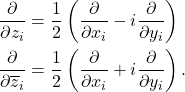
It is customary to substitute the the tangent space  with
with  and give this local coordinates by the Wirtingen derivatives
(1) 
with associated covectors
(2) 
The tangent space can then be decomposed into  where
where  is the vector bundle of p partial derivatives of the form
  and
and  of the form
  . This is actually the eigenspace decomposition of
  given by the (lift of the) the almost complex structure
  , which acts on
  by multiplication by
  and on
  by multiplication by
  . The decompositions are also inherited (in the obvious way) by arbitrary tensor fields. Explicitly on forms we have
![\[\Omega^{(p,q)}(M) =\underbrace{\Omega^{(1,0)}\wedge...\wedge\Omega^{(1,0)}}_{p}\wedge \underbrace{\Omega^{(0,1)}\wedge ... \wedge \Omega^{(0, 1)}}_{q}\]](https://www.mathblog.realhjelp.no/wp-content/ql-cache/quicklatex.com-1dfedbf55cdf2ba718f9f8fe7009f6b9_l3.png "Rendered by QuickLaTeX.com")
It is also customary to decompose the exterior differential as
![\[d = \partial + \overline{\partial}\]](https://www.mathblog.realhjelp.no/wp-content/ql-cache/quicklatex.com-8501b2411b0d4ae1373191ac7e2c893b_l3.png "Rendered by QuickLaTeX.com")
 and
and  are defined on
  -forms by
 ![\[\partial\left(\sum_{|I \cup J|= k} \alpha_{I,J}dz_I\wedge d\overline{z}_J\right)= \sum_{|I \cup J|= k }\sum_{r\not\in I}\frac{\partial \alpha_{I, J}}{\partial z_r} dz_r\wedge dz_I\wedge d\overline{z}_J\]](https://www.mathblog.realhjelp.no/wp-content/ql-cache/quicklatex.com-ab7ceb40dec82b7cd49da8e4380897e2_l3.png "Rendered by QuickLaTeX.com")
![\[\overline{\partial}\left(\sum_{|I \cup J|= k} \alpha_{I,J}dz_I\wedge d\overline{z}_J\right)= \sum_{|I \cup J|= k }\sum_{r\not\in J}\frac{\partial \alpha_{I, J}}{\partial \overline{z_r}} d\overline{z}_r\wedge dz_I\wedge d\overline{z}_J\]](https://www.mathblog.realhjelp.no/wp-content/ql-cache/quicklatex.com-fbd186fd849fe92d5f79351d4cc64a43_l3.png "Rendered by QuickLaTeX.com")
where we sum over all multiindices
 and of
  . We denote again by
 their (formal, since unbounded) adjoints with respect to the inner product.
There is an explicit formula for the adjoint operators, using the Hodge- operator, namely,
![\[\Lambda = \star^{-1} \circ L \circ \star\]](https://www.mathblog.realhjelp.no/wp-content/ql-cache/quicklatex.com-30046ded69be1417e4ac4c51b2204b46_l3.png "Rendered by QuickLaTeX.com")
similar expressions exist for all adjoints. This is how one defines adjoints for non-compact manifolds, and most of the results from Hilbert space theory extends word for word to the the non-compact setting by working locally on the (sheaf)
 .
.
A manifold  together with a closed 2-form
  for which
  is a nowhere vanishing volume form, is called a symplectic manifold. Equivalently, is a closed 2-form which gives a non-degenerate pairing of tangent vectors. Note that all Kahler manifolds are symplectic with respect to the Kahler form, but with added structure of a Riemmannian and complex manifold. We also call the operator
![\[L : \Omega^{r} \to \Omega^{r+2} \qquad \alpha \mapsto \omega \wedge \alpha\]](https://www.mathblog.realhjelp.no/wp-content/ql-cache/quicklatex.com-c2b7542ea19a470c5fb9e3b5da69559c_l3.png "Rendered by QuickLaTeX.com")
 -forms, that is
 ![\[L^k : \Omega^{n-k} \to \Omega^{n+k} \qquad \alpha \mapsto \omega^k \wedge \alpha\]](https://www.mathblog.realhjelp.no/wp-content/ql-cache/quicklatex.com-86e198ebfd16728e34fbf50147619088_l3.png "Rendered by QuickLaTeX.com")
The symplectic case
On arbitrary symplectic manifolds we have the following important theorem –
the symplectic form on  , the Lefschetz operator
 ![\[L^k : \Omega^{n-k} \to \Omega^{n+k} \qquad \alpha \mapsto \omega^k \wedge \alpha\]](https://www.mathblog.realhjelp.no/wp-content/ql-cache/quicklatex.com-117a2c1e68038605535b2a07dc796d07_l3.png "Rendered by QuickLaTeX.com")
 -modules.
Step 1) Let
 be as above and let
  be a trivializing neighborhood of . Write
  for a vector space
  of dimension . On
  we have
 (3) 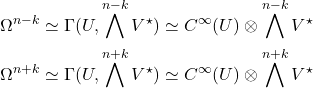
![\[L^k(f\otimes v) = f\otimes \omega^k\wedge v.\]](https://www.mathblog.realhjelp.no/wp-content/ql-cache/quicklatex.com-230b1e0366799d23fa366077f47bf9d8_l3.png "Rendered by QuickLaTeX.com")
To show that  is bijective it suffices to show it is bijective on a trivializing cover (employ the sheaf axioms here), and on a trivializing cover, we have now reduced the problem to showing that the operator
  is an isomorphism of vector spaces. Since these are all of equal dimension, we will only need to check that the map is injective.
Step 2) (borrowed from Prop.1.1 of [1]) Let us prove this by induction on . Assume first that  , then
![\[\omega^n\wedge -: \mathbb{R} \to \bigwedge^nV^\star\]](https://www.mathblog.realhjelp.no/wp-content/ql-cache/quicklatex.com-0caff374ddcd768963d5d3c1cd87bf92_l3.png "Rendered by QuickLaTeX.com")
is symplectic. Next assume this holds for some , we will show it also holds for  . If
. If  then clearly
  , hence for any vector
  we have
 (4) 
where
 is the the contraction operator. Now by assumption
  so we are left with the second term
 (by the induction hypothesis) 
This concludes the proof.
Tracing the proof of the above theorem, we can make the following observations
- We did not needed was closed, just that is a nowhere vanishing volume form on .
- If we are given a 2-form for which the map
 is injective for some
  , the the wedge powers of determines an isomorphism
for all![\[\Omega^{n-k} \to \Omega^{n+k}\]](https://www.mathblog.realhjelp.no/wp-content/ql-cache/quicklatex.com-497b1847839741d6d680956cde6c6174_l3.png "Rendered by QuickLaTeX.com")
 .
. - Noting that
 since if is any closed form
  , so induces a map of cohomology groups
Not much can be said about this map though, it may or may not be an isomorphism. Symplectic manifolds for which these maps are isomorphisms for all![\[L^k: H^{n-k} \to H^{n+k}.\]](https://www.mathblog.realhjelp.no/wp-content/ql-cache/quicklatex.com-732790cc15d22cf4727948d59e51b3db_l3.png "Rendered by QuickLaTeX.com")
 are said to have the strong (or hard) Lefschetz property.
The Kahler case
In the comfort of Kahler geometry we can say significantly more about the the induced Leftshcetz operators on the level of cohomology, namely –
 be a compact Kahler manifold of real dimension . Then the Lefschetz operator induces an isomorphism of chomomology spaces for all
 ![\[L^k: H^{n-k}(M) \to H^{n+k}(M)\]](https://www.mathblog.realhjelp.no/wp-content/ql-cache/quicklatex.com-6baf75ce9ba844a98de28fc253db1bca_l3.png "Rendered by QuickLaTeX.com")
The proof of this theorem relies on the two following fundamental theorems of Hodge theory –
 be a compact oriented Riemannian manifold, then every cohomology class has a unique harmonic representative. the cohomology spaces are all finite dimensional.
and an equally fundamental theorem in Kahler geometry –
be a(ny) Kahler manifold,  the Lefschetz operator, , the differential defined above, and , their (formal) adjoints, then
 (5) ![\begin{align*} [L, \partial] &= [L, \overline{\partial}] = 0 \\ [L, \partial^\star] &= i \overline{\partial} \\[L, \overline{\partial}^\star] &= - i \partial \end{align*}](https://www.mathblog.realhjelp.no/wp-content/ql-cache/quicklatex.com-2683a0d63abb513b5c6b6e5660501eec_l3.png "Rendered by QuickLaTeX.com")
We will also need the following two significantly less fundamental lemmas, the first of which is a consequence of the fact that  , the second is valid for any Kahler manifold
![\[\partial^2 = 0 \qquad \overline{\partial}^2 = 0 \qquad \overline{\partial}\partial = -\partial \overline{\partial}\]](https://www.mathblog.realhjelp.no/wp-content/ql-cache/quicklatex.com-01b16da4878644f0328f67df02ea3042_l3.png "Rendered by QuickLaTeX.com")
 .
.Claim – To prove the hard Lefschetz theorem it is sufficient to show that
![\[[L, \Delta] = 0.\]](https://www.mathblog.realhjelp.no/wp-content/ql-cache/quicklatex.com-89f3854d1103c711e491ab737f544e4c_l3.png "Rendered by QuickLaTeX.com")
![[L, \Delta] = 0](https://www.mathblog.realhjelp.no/wp-content/ql-cache/quicklatex.com-0e5f2e161987831a29c4b375498743f5_l3.png "Rendered by QuickLaTeX.com") , then
, then ![[L, \Delta]^\star =[\Delta^\star, \Lambda] =[\Delta, \Lambda] = 0](https://www.mathblog.realhjelp.no/wp-content/ql-cache/quicklatex.com-2b6a3baf9c87e4ad568b651a68a207e4_l3.png "Rendered by QuickLaTeX.com") (since
(since  is self adjoint). Recall that the adjoint of a bijective map is bijective, hence in our case since of Theorem 1 is bijective,
  is also bijective. Let
  denote the space of harmonic
  -forms on , then in particular both
 ![\[L^k: \mathcal{H}^{n-k} \to \mathcal{H}^{n+k}\]](https://www.mathblog.realhjelp.no/wp-content/ql-cache/quicklatex.com-a9bb082c1601ca5bd89ba06bc6af20b5_l3.png "Rendered by QuickLaTeX.com")
![\[\Lambda^k:\mathcal{H}^{n+k} \to \mathcal{H}^{n-k}\]](https://www.mathblog.realhjelp.no/wp-content/ql-cache/quicklatex.com-a90b935e1f876f2a49a1f0aed174fbac_l3.png "Rendered by QuickLaTeX.com")
![\[H^{n-k} \leftrightarrow H^{n+k}.\]](https://www.mathblog.realhjelp.no/wp-content/ql-cache/quicklatex.com-34002d58d828d68b348c444f0b29f7a9_l3.png "Rendered by QuickLaTeX.com")
 -vector spaces (Theorem 3 above) we conclude that they have the same dimension and is a bijection.
Luckily it turns out that ![[L, \Delta]= 0](https://www.mathblog.realhjelp.no/wp-content/ql-cache/quicklatex.com-faa886a43557d132181c063a74a4c1e0_l3.png "Rendered by QuickLaTeX.com") , (or else the preceding paragraph would quite the waist of space) and here is why –
, (or else the preceding paragraph would quite the waist of space) and here is why –
(lemma 2) ![\begin{align*}L\Delta &= L(d^\star d + dd^\star) = 2L(\partial^\star \partial + \partial \partial^\star) \\&= 2([L, \partial^\star] - \partial^\star)([L, \partial] - \partial L) + ([L, \partial] - \partial)\partial^\star([L, \partial^\star] - \partial^\star) \\&= 2((\partial^\star \partial + \partial \partial^\star)L - 2i (\partial \overline{\partial} + \overline{\partial} \partial)) \tag{Theorem 4}\\&= \Delta L \tag{Lemma 1}\end{align*}](https://www.mathblog.realhjelp.no/wp-content/ql-cache/quicklatex.com-d350029d5bdef6fa0a3afa1ffdb9dfa5_l3.png "Rendered by QuickLaTeX.com")
This concludes the proof of the hard Lefschetz theorem.
Remarks
- The isomorphism
 holds for any Kahler manifold, even non-compact. For compact manifolds, we defined the adjoint in the beginning by either
  or as the actual adjoint of with respect to the -inner product. On non-compact complex manifolds the former definition makes sense and inherits many properties of the Hilbert space adjoint. In our case, the map is injective if and only if its adjoint
  is surjective, and vice verca (just like normal linear operators on Hilbert spaces). To see why this is so, note that it suffices to check the claim for germs since is a sheaf map of
  , and morphisms of sheaves are injective/surjective if and only the induced map on the germs is injective/surjective respectively. Given this, we may assume the representative of the germ is compactly supported (why?) so it follows that it suffices to check the claim on compactly supported forms, but the compactly supported forms have a well defined -inner product (as defined above) and the claim follows by noting that the adjoint with respect to this inner product agrees with
  (which is straightforward to verify).
 - The isomorphism of Theorem 2 works well with the usual decomposition the cohomology groups of compact Kahler manifolds, meaning
where![\[L^{n-k}: H^{(p, q)} \to H^{(n-q, n-p)}\]](https://www.mathblog.realhjelp.no/wp-content/ql-cache/quicklatex.com-ded1c119f77d37a29f23382cf188e881_l3.png "Rendered by QuickLaTeX.com")
 is an isomorphism. This follows since is a
  -form.
Consequences and counterexamples
For non-compact Kahler manifolds, the theorem fails miserably, take for instance
![\[\mathbb{R} = H^0(\mathbb{C}\backslash \{0\}) \neq H^2(\mathbb{C}\backslash \{0\}) = 0.\]](https://www.mathblog.realhjelp.no/wp-content/ql-cache/quicklatex.com-027faef153be9bcec1fba235b8ace5d1_l3.png "Rendered by QuickLaTeX.com")
Another fun property of the theorem is that if  denotes the i’th Betti number which are the real dimensions of the cohomology spaces, then
![\[\{b_{2i}\}_{i=0,..., n}\]](https://www.mathblog.realhjelp.no/wp-content/ql-cache/quicklatex.com-9575223f982b065b6d2b48c211b39525_l3.png "Rendered by QuickLaTeX.com")
![\[\{b_{2i-1}\}_{i=1,.., n}\]](https://www.mathblog.realhjelp.no/wp-content/ql-cache/quicklatex.com-b6c5f9bf23a05c6d1c218baf4166632a_l3.png "Rendered by QuickLaTeX.com")
 is an isomorphism we must have that
 ![\[L: H^{2i}(M)\to H^{2(i+1)}(M)\]](https://www.mathblog.realhjelp.no/wp-content/ql-cache/quicklatex.com-6499460e432429c07e2e6be12f9b23a8_l3.png "Rendered by QuickLaTeX.com")
Lefschetz decomposition
Another important theorem which puts further restrains on the cohomology structure of Kahler manifolds is the Lefschetz decomposition theorem. Let’s define
![\[P^k= \{ \alpha \in \Omega^k(M) ~|~ \Lambda(\alpha) = 0 \}\]](https://www.mathblog.realhjelp.no/wp-content/ql-cache/quicklatex.com-d3a2b466e974667c8655daf325d7c54c_l3.png "Rendered by QuickLaTeX.com")
Elements of  are called primitive forms. We have an equivalent description of primitive forms given by
![\[P^k = ker(L^{n-k+1}: H^k \to H^{2n-k+2})\]](https://www.mathblog.realhjelp.no/wp-content/ql-cache/quicklatex.com-6454209e1efdee858714c238e9d22483_l3.png "Rendered by QuickLaTeX.com")
the equivalence class of these elements in  . The statement of the theorem is as follows
be a Kahler manifold (not necessarily compact) , then we have the following decomposition
. The statement of the theorem is as follows
be a Kahler manifold (not necessarily compact) , then we have the following decomposition ![\[H^k(M) \simeq \bigoplus_{r\in \mathbb{N}} L^{r}(P^{k-2r}).\]](https://www.mathblog.realhjelp.no/wp-content/ql-cache/quicklatex.com-4099534577fe47307c9d04d299675047_l3.png "Rendered by QuickLaTeX.com")
Define
![H=[L,\Lambda]](https://www.mathblog.realhjelp.no/wp-content/ql-cache/quicklatex.com-10a6fc4746fb4a33373dac29cdeef92d_l3.png "Rendered by QuickLaTeX.com") . See [2] Proposition 1.2.26 for the proof that
. See [2] Proposition 1.2.26 for the proof that  , where
  is the projection. Most of the complexity of the proof is hidden in this assertion, which is where we need the requirement that is Kahler. If one believes this, then it is easy to verify that we have the commutator relations
![\[[H, L] = 2L \qquad [H, \Lambda] = -2\Lambda \qquad [L, \Lambda] = H\]](https://www.mathblog.realhjelp.no/wp-content/ql-cache/quicklatex.com-aad7a4cc108c8e218aa33c5652c8b99c_l3.png "Rendered by QuickLaTeX.com")
Recall that the Lie algebra of the special linear group of  -matrices with coefficients in
  (i.e.
(i.e.  ) is spanned by
\begin{array}
& X = \begin{pmatrix} 0&0\\ 1&0
\end{pmatrix} &
Y = \begin{pmatrix} 0&1\\ 0&0
\end{pmatrix} &
Z = \begin{pmatrix} 1&0\\ 0&-1
\end{pmatrix}
\end{array}
with relations
![\[[Z, X] = 2X \qquad [Z, Y] = -2Y \qquad [X,Y] = Z\]](https://www.mathblog.realhjelp.no/wp-content/ql-cache/quicklatex.com-99f3343e6e4f65ef433f2346f263aaae_l3.png "Rendered by QuickLaTeX.com")
hence we get a representation of
by the assignemnt ![\[X\mapsto L\qquad Y\mapsto \Lambda \qquad Z\mapsto H\]](https://www.mathblog.realhjelp.no/wp-content/ql-cache/quicklatex.com-3e2b30ce0f6a703510d81c028ae7fb50_l3.png "Rendered by QuickLaTeX.com")
Since
is semisimple, and  is a finite dimensional complex vector space, Weil’s theorem asserts that the representation is totally decomposable, that is, it can be written as a linear combination of irreducible representations.
Since  is diagonal (and invertible), we may decompose
  into eigenspaces of . If
  , then
  , so
, so  is an eigenvector of with distinct eigenvalue hence must be linearly independent from
  . Continuing inductively, and using the fact that the vector space is finite dimensional, there must be a non-zero such that
  . Now let
![\[W_v = span\{v, Lv, L^2v, ... \}.\]](https://www.mathblog.realhjelp.no/wp-content/ql-cache/quicklatex.com-efd3f4f404fa1ee861438f1b6bf2d51e_l3.png "Rendered by QuickLaTeX.com")
 and
and  . It turns out that
  hence
hence  is a subrepresentation which is clearly irreducible, being cyclic. Continuing the process we can decompose into irreducible components spanned by
  for
for  . This concludes the proof.
The above decomposition is also induces a decomposition of
![\[\Omega^k_\mathbb{C} = \bigoplus_{r\in \mathbb{N}} L^{r}(P^{k-2r})\]](https://www.mathblog.realhjelp.no/wp-content/ql-cache/quicklatex.com-4f54fbc122d9afc7bc058e3aec9da28f_l3.png "Rendered by QuickLaTeX.com")
-inner product.
[1] Bryant, Griffiths, Grossman – Exterior Differential Systems andEuler-Lagrange Partial Differential Equations.[2] Huybrechts – Complex geometry
[3] Voisin – Hodge theory and complex algebraic geometry.