Table of Contents
Introduction
Given a vector space  of dimension
  over an algebraically closed field
  , the Grassmannian
  is the collection of all
  -dimensional subspaces of with the quotient topology. It is immediate that
  , hence we may think of it as a generalization of the usual projective spaces. In fact is itself a projective variety (see the Plücker imbedding).
Since the Grassmannian has been such an important tool in algebraic geometry, unfortunately parts of this post will require some background knowledge of schemes and locally free sheaves over schemes.
Smooth structure
The simplest way to see that is indeed a smooth manifold is to realize it as the quotient space by some group action. Let’s recall the following important theorem
An action is called free if only the identity element has fixed points, and is called proper if the map  is a proper map. For convenience, we note that if the group action is free and properly discontinuous the above quotient becomes a real covering map.
We may define to be the quotient of all full rank matrices  modulo the left action of
  , where we think of the rows of
  as spanning the associated vector subspace, and the left action of as interchanging bases for
  .
.
Alternatively, pick a basis, or just an inner product for , assign to each -dimensional subspace  an element in the unitary group
  , by taking any orthonormal basis for
  and extending to an orthonormal basis for . To make this correspondence bijective we need to mod out by any orthonormal base change of and
  . Thus as a set we have
![\[Gr(r, V_n) \simeq \frac{U(n)}{U(r)\times U(n-r)}\]](https://www.mathblog.realhjelp.no/wp-content/ql-cache/quicklatex.com-102211d957d9ab2fe0f34f5d29bb4871_l3.png "Rendered by QuickLaTeX.com")
 denotes a block diagonal matrix.
The action of on  , it is clearly smooth and free (check this!) and since
  is compact and Hausdorff for any
  , the action is automatically proper, since any continuous map
  of compact Hausdorff spaces is proper.
The other way – The above construction seems slightly unsatisfactory as it gives us no idea of how the charts are actually constructed, without tracing the steps in the proof of Theorem 1. To remedy this shortcoming, fix a basis for  and write every element in
  as matrices
  where the rows represents the spanning vectors of . The Plucker imbedding gives us an imbedding
![\[Gr(r, V_n) \to \mathbb{P}(\bigwedge^rV_n)\]](https://www.mathblog.realhjelp.no/wp-content/ql-cache/quicklatex.com-3327150ad9656c04df4472fdd02d3b67_l3.png "Rendered by QuickLaTeX.com")
The local homogeneous coordinate charts inherited from  gives the socalled Plücker coordinates (to be defined below) on . Explicitly, it gives us a set of homogeneous coordinates on given by
![\[M^W_{r\times n}\mapsto [|M_{I_1}|, ..., |M_{I_{n \choose r}}|]\]](https://www.mathblog.realhjelp.no/wp-content/ql-cache/quicklatex.com-7876553e60f115ad8e3105ddf9c9f089_l3.png "Rendered by QuickLaTeX.com")
 ranges over all -minors of the matrix . Restricting to the local chart
  , where
  and letting act on
  such that
  we get a chart
 ![\[M^W_{r\times n} \mapsto \left( \frac{|M_{I_2}|}{|M_{I_1}|}, ..., \frac{|M_{I_{n\choose r}}|}{|M_{I_1}|}\right) = \left( |M_{I_2}|, …, |M_{I_{n\choose r}}| \right) .\]](https://www.mathblog.realhjelp.no/wp-content/ql-cache/quicklatex.com-7d65042092b8b6e711d7576152b88a34_l3.png "Rendered by QuickLaTeX.com")
By fixing the first -minor of the to be the identity matrix we may write every element in uniquely it as a matrix
![\[M^W_{r\times n} = \begin{bmatrix} 1 & 0 & ... & 0 & a_{11} &... & a_{1{n-r}} \\0 & 1 & ... &0 &a_{21} & ... & a_{2{n-r}} \\&& ... & &&&\\0 & 0 & … & 1 & a_{r1} &… & a_{r{n-r}} \end{bmatrix}\]](https://www.mathblog.realhjelp.no/wp-content/ql-cache/quicklatex.com-0e7c31d134730cca6fceb18bb008c934_l3.png "Rendered by QuickLaTeX.com")
This gives us a chart after the identification of  .
.
Plücker imbedding
The Grassmannian is a projective variety, meaning it is given as the zero locus of a family of homogeneous polynomials of the same degree (called the Plücker relations). This is usually show by means of the Plücker embedding which I will state and prove here.
Let be an -dimensional vector space and let be the Grassmannian of -dimensional subspaces. The Plücker imbedding is given by the map
![\[p: Gr(r, V_n) \to \mathbb{P}(\bigwedge^rV_n)\]](https://www.mathblog.realhjelp.no/wp-content/ql-cache/quicklatex.com-9a28298cad68c300af00e53932325cda_l3.png "Rendered by QuickLaTeX.com")
 to the (totally) decomposable tensor
 ![[e_1\wedge ... \wedge e_r]](https://www.mathblog.realhjelp.no/wp-content/ql-cache/quicklatex.com-d7faad3e7d0fa2f9f117c06d6ef34cf6_l3.png "Rendered by QuickLaTeX.com") .
.
The map is well defined since for any basis transformation  given by a linear map
  , extend
  by the identity operator to the whole of , and note that
![\[det(T) e_1\wedge ... \wedge e_r = v_1 \wedge ...\wedge v_r.\]](https://www.mathblog.realhjelp.no/wp-content/ql-cache/quicklatex.com-00b5aa30fab7acc087ba44c626de72a0_l3.png "Rendered by QuickLaTeX.com")
which are identified in
. It is also easily seen to be injective, so as a set the Grassmannian are precisely the decomposable tensors of . To show it is closed in the Zariski topology I will follow the book of Harris (Algebraic Geometry – A First Course).
Some multilinear algebra prerequisites
For any -dimensional vector space over an algebraically closed field , fix a non-zero form  . We can construct a bilinear map
  given by
![\[\langle \alpha, \beta \rangle = \sigma (\alpha \wedge \beta).\]](https://www.mathblog.realhjelp.no/wp-content/ql-cache/quicklatex.com-e9ae8f1e3432d44321f0bd34a1a523eb_l3.png "Rendered by QuickLaTeX.com")
This pairing is non-degenerate, that is if  for all
  then
then  . Hence we have an identification
![\[\bigwedge^r W \simeq \left(\bigwedge^{n-r} W\right)^\star \simeq \bigwedge^{n-r} W^\star\]](https://www.mathblog.realhjelp.no/wp-content/ql-cache/quicklatex.com-56a9a21b634340f12ad08655dc358a80_l3.png "Rendered by QuickLaTeX.com")
 . Note how this is natural up to choice of form
  , hence the identification
 ![\[\mathbb{P}(\bigwedge^rW) \simeq \mathbb{P}(\bigwedge^{n-r}W^\star)\]](https://www.mathblog.realhjelp.no/wp-content/ql-cache/quicklatex.com-6addf6d7c21c524394ec52024a4b4b2d_l3.png "Rendered by QuickLaTeX.com")
In a basis  for with corresponding dual basis
  and setting
  this identification sends
![\[e_I\mapsto \lambda\star(e^\star_I)\]](https://www.mathblog.realhjelp.no/wp-content/ql-cache/quicklatex.com-960950eeb8cbc9a06c7322b47d3c81b9_l3.png "Rendered by QuickLaTeX.com")
 is the Hodge star operator. For example, the identification sends
 ![\[e_1\wedge ... e_r \mapsto \lambda e^\star_{r+1}\wedge ... \wedge e_n^\star\]](https://www.mathblog.realhjelp.no/wp-content/ql-cache/quicklatex.com-c59d9beb5af1d8a9d06e6f94d327d1bc_l3.png "Rendered by QuickLaTeX.com")
We will also need some basic facts about dual maps for the proof of the next theorem.
If  is a linear map with dual map
  (i.e. the map
  ), then if we fix a basis for and , the matrix representation of
  with respect to the corresponding dual basis is the transposed of the matrix representation of with respect to said basis.
The rank of the map is the dimension of the image. Since the dimension of the columnspace and rowspace of matrix are equal, it follows that
![\[rank(T) = rank(T^\star)\]](https://www.mathblog.realhjelp.no/wp-content/ql-cache/quicklatex.com-473238a79a9636d1ed85a7b348d514ea_l3.png "Rendered by QuickLaTeX.com")
Lastly the following isomorphism is crucial
(1) ![\[Im(T^\star) = (Ker(T))^\perp\]](https://www.mathblog.realhjelp.no/wp-content/ql-cache/quicklatex.com-93c7a0a42fd29fa26b7823a4f6c8fec5_l3.png "Rendered by QuickLaTeX.com")
where  denotes the annihilator subspace of
  in
in  . The main result now is the following theorem
 is closed in the Zariski topology.
 is the zero locus of a family of homogeneous polynomials of degree 2 (called ‘quadrics’). For each
  define the two maps
 (1) 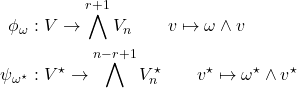
 is totally decomposable if and only if the rank of
  (or equivalently
  ) are as small as possible, which here means
![\[rank(\phi_\omega) = n-r\]](https://www.mathblog.realhjelp.no/wp-content/ql-cache/quicklatex.com-bfdb871af2e68348a27d9b51b404433e_l3.png "Rendered by QuickLaTeX.com")
![\[rank(\psi_{\omega^\star}) \leq r.\]](https://www.mathblog.realhjelp.no/wp-content/ql-cache/quicklatex.com-b0b4ac0d4ba2561dfbd64653ca3e138a_l3.png "Rendered by QuickLaTeX.com")
is totally decomposable, say  for some basis, then
  . This implies
  . Now assume
  , let
, let  be a basis such that
  is a basis for
  . Let
. Let  be the usual multivector basis expansion of , Since
  it follows that
  for each multiindex
  not containing
  , hence
  . The proof for is analogous.
Now if we dualize these maps and writing  for the correspondence between and we claim that is totally decomposable if and only if
![\[\langle \phi_\omega^\star (b), \psi_{\omega^\star}^\star (a) \rangle = 0 \qquad \forall ~ a\in V^\star, ~ b\in V\]](https://www.mathblog.realhjelp.no/wp-content/ql-cache/quicklatex.com-ea3eb83d270a5c3bcf39c3f26ec9a883_l3.png "Rendered by QuickLaTeX.com")
 by non-degeneracy. To prove this claim, assume
  is totally decomposable, and using equation (1) we get

Conversely assume  and (for contradiction) that is not decomposable. Then by previous observations
  while
while  , which which implies that the image of
  would not fit inside the kernel of . A contradiction has arisen!
It follows from this that the Grassmannian can be written as the zero locus of the family
![\[\sum_k\phi^{ir}_\omega \psi^{jr}_{\omega^\star}\]](https://www.mathblog.realhjelp.no/wp-content/ql-cache/quicklatex.com-fb521ef240fbb4b561f6d07b2106d3c9_l3.png "Rendered by QuickLaTeX.com")
 are the entries of the matrix representations, each of which is a linear function of , hence they are all quadratic polynomials in
. Now a final check to see it is actually a projective variety –
is irreducible sending a matrix to all it’s r-minors is a parametrization of the affine cone over
  , which is the space
 ![\[\{ (x_1, ..., x_{n\choose r}) ~|~ [x_1 : … : x_{n\choose r}] \in p(Gr(r, V_n)) \} \cup \{0 \}.\]](https://www.mathblog.realhjelp.no/wp-content/ql-cache/quicklatex.com-9daed5a377b9da5d8d46c339854f3b87_l3.png "Rendered by QuickLaTeX.com")
 is irreducible, we must have that the image is irreducible (or else the preimages would be a decomposition of into closed disjoint sets). Lastly a projective variety is irreducible if and only if its affine cone is irreducible. This concludes the proof.
 The -scheme associated with this variety is hence
![\[Proj(K[x_1, ..., x_{n \choose r}])/ \langle f_1, .., f_r \rangle\]](https://www.mathblog.realhjelp.no/wp-content/ql-cache/quicklatex.com-18c85138c1f173731199716258a6074b_l3.png "Rendered by QuickLaTeX.com")
 are the “Plücker relations” (the homogeneous degree 2 polynomials) constructed above.
Homogeneous coordinates
The Plücker imbedding gives us a chance to write the Grassmannian in the homogeneous coordinates of  , often called the Plücker coordinates. First we need to fix a basis
  and assume
  where
where  are linearly independent and denote by
  the usual basis for
  giving them any ordering you like (like the lexicographical). Now the imbedding of into is
(2) ![\begin{align*}[W] &\mapsto [v_1\wedge ... \wedge v_r] \\ &= [ \sum_{j=1}^n \lambda^1_j e_j\wedge ... \wedge \sum_{j=1}^n \lambda^r_j e_j] \\ &= [ \sum_{i= 1}^{{n \choose r}} |M_{I_i}| e_{I_i}]\\&=:[ |M_{I_1}| : ... :|M_{I_{n\choose r }}|]\end{align*}](https://www.mathblog.realhjelp.no/wp-content/ql-cache/quicklatex.com-642fa0705773202386f985b5ccd1d013_l3.png "Rendered by QuickLaTeX.com")
where
 is the matrix
  (the matrix whose
  ‘th column is ),
  is the determinant of the
  matrix determined by the multiindex
  . Note that not all these minors can be zero, since the matrix
  has rank .
Functorial view
Be warned, this section is pretty sketchy as I don’t really think I will ever find a use for this construction in my work, but it’s good to at least know this material exists.
Recall that the lemma of Yoneda let’s us associate to any object in a category  , a functor
  which uniquely determines the element
  . Explicitly the lemma states that the above map induces a full and faithful imbedding
![\[\mathcal{C}\to Fun(\mathcal{C}^{op} \to (Sets)).\]](https://www.mathblog.realhjelp.no/wp-content/ql-cache/quicklatex.com-940fede376e28ce37a8ad699ce0af438_l3.png "Rendered by QuickLaTeX.com")
Throughout this section let  be our Grassmannian which you can think of as a projective variety, a scheme over the scalar field or just a smooth manfiold over
  if you have no need for the added generality. The associated functor of the Grassmannian
  has a particularly nice equivalent definition, which will be presented shortly.
To prove this equivalence, we need to define the universal bundle over , (or equivalently the universal exact sequence  ), which is the map
![\[\phi_u: X\times V_n \to Q\]](https://www.mathblog.realhjelp.no/wp-content/ql-cache/quicklatex.com-057b8bc9d29f510223fb93b9aa3357b3_l3.png "Rendered by QuickLaTeX.com")
 is the quotient of the trivial bundle
  by the tautological bundle
  , that is, each fiber of Q at a point
  is just
  .
.
The following important theorem which holds (mutatis mutandi) over any base scheme, but we restrict our attention to -schemes where is the (algebraically closed) scalar field of , will be the essential step in the proof of the equivalence.
 The set of all morphisms of K-schemes
 locally free rank k sheaves on
  with r-nonvanish. sections
- rank r vector bundles on with r-nonvanish. sections
 , where
  is a rank vector bundle on
  , where is a rank r locally free sheaf on
), which sends the trivial bundle to the free sheaf (of the same rank). Let us try to show (1)=(3) which is a generalization of Theorem 16.4.1 of [2]. Given a bundle on and global sections  , construct a morphism
  by the map
 ![\[y \mapsto s_1(y), ..., s_n(y) \subset V_n.\]](https://www.mathblog.realhjelp.no/wp-content/ql-cache/quicklatex.com-c6a982598cac7afb63d3e40c632e0589_l3.png "Rendered by QuickLaTeX.com")
The phrase “-non vanishing sections” is misleading, but you can only be so precise in the margin. It means that at each point  the sections of the -sheaf or vector bundle on ,
  generate near
  . In the case of a vector bundle this means they are local trivializations of the bundle, while for sheaves this means they generate the free sheaf of rank
  , where
  is a neighborhood of .
With Theorem 4 at our disposal, it is not that difficult to show that the Grassmannian functor is naturally equivalent to the following functor
(3) 
where  are either locally free sheaves of rank k or vector bundles of rank over , depending on the working category,
  is the structure sheaf of treated as an -module and
  is the trivial vector bundle over the scheme . These identifications again rely on the equivalence of categories of locally free sheaves and vector bundles over a fixed base scheme, and the fact that any surjection
 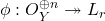 has a locally finite kernel of rank
  .
.
If this makes no sense, it is strongly recommended that one sticks to the category of varieties with ordinary vector bundles. The reason I mentioned it is that in this identification we send trivial bundles of rank to free sheaves of rank . Hence one often identifies  in the literature. We also used
  . Now finally –
 is naturally equivalent to the functor
  .
.Let
 be a morphism of (schemes|varieties), then
![\[\begin{matrix}Hom(Y, X) & \xrightarrow{ g\circ f}& Hom(Y', X)\\ \downarrow{g^*\phi_u} & & \downarrow{g^*\phi_u} \\\{ \phi_Y: Y\times V_n \twoheadrightarrow L_r^Y\} &\xrightarrow[\phi \mapsto f^\star\phi_Y]{} &{ \phi_{Y'}: {Y'}\times V_n \twoheadrightarrow L_r^{Y'}} \end{matrix}\]](https://www.mathblog.realhjelp.no/wp-content/ql-cache/quicklatex.com-2f56d20f22e6dacde25df1cce6058449_l3.png "Rendered by QuickLaTeX.com")
The commutativity of this diagram follows by the fact that
 . The maps
  (the universal bundle defined above) is actually invertible. Let
  , now the map
  given by
  is an inverse to the map
  .
.To be continued….
Subsequent post will cover the tangent space of  , some subvarietes, and introduce the Schubert cells.
[2] – R. Vakil, Fundations of algebraic geometry : The rising sea (November 18, 2017 edition)